
No doubt, Local SEO has become one of the major growth factors, changing how businesses reach out to customers and build credibility. This has become even more important as Google constantly reports that a large share of searches have local intent and most local searches lead to an in-person visit within a day.
This even makes it critical to show up in local search, especially if you want to increase your real-world sales.
For instance, starting from Google Business Profile optimization and review signals to local content and entity consistency across the web, every detail now influences visibility and credibility.
In today’s guide, we have highlighted the essential strategies that improve rankings and how to grow your local customer base effectively.
What is Local SEO?
Local SEO is all about optimizing your online presence to attract nearby customers. The process usually targets location-based searches, Google Maps, and AI-powered discovery platforms. These are all designed to drive your business right in front of ready-to-buy local customers.
Local search has evolved notably. It now spans Google Maps, voice search, LLM, and even social media platforms as well. Google Business Profiles are now handling business calls, directions, and first impressions, and make businesses easily found by those customers who actually need your services now.
In local SEO, Google mainly ranks your business on three factors. These include relevance, distance, and prominence. For instance, the more consistently your business appears online, the stronger your authority signals become. This overall strengthens your credibility and helps both search engines and AI systems recognize your business as a trusted local authority.
How Local SEO Works for Small Businesses?`
Include a small storefront icon representing a local business at the bottom, connected with dotted lines to the search results. Use a clean, minimal, professional design style with soft blue, green, and white tones.
ALT: How Local SEO Works for Small Businesses?
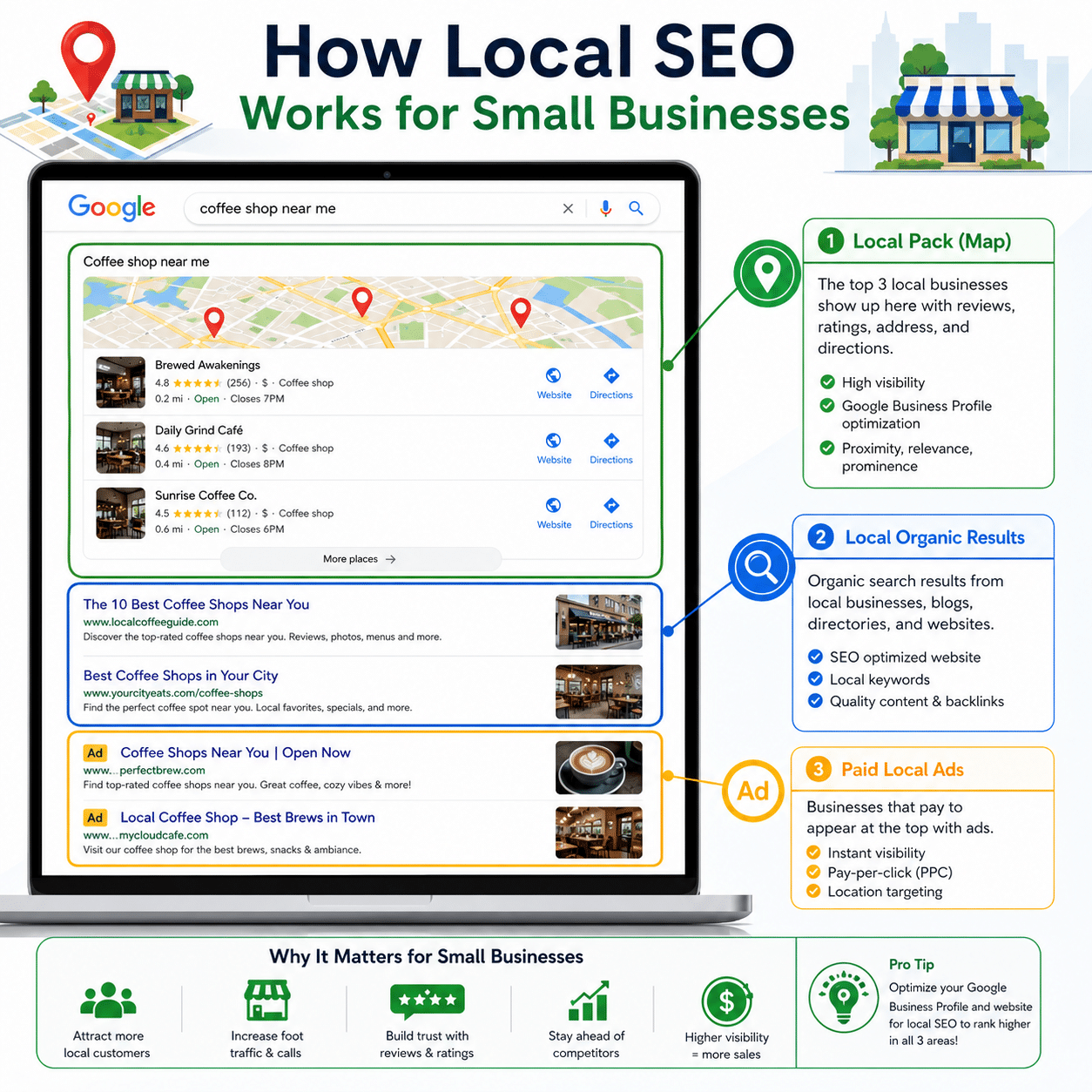
Local SEO helps small businesses get customers nearby when they are searching for any desired products or services. For instance, when they are searching with local intent like “plumber near me” or “coffee shop near me,” Google shows these types of results:
| Local Pack (Map) | Map with 3 business listings at the top |
| Local Organic | Standard search results filtered for location |
| Paid Local | Google Ads with location targeting |
However, local SEO for small businesses breaks down into a few categories.
This would be GBP signals at 32%, on-page signals at 19%, review signals at 16%, link signals at 15%, behavioral signals at 8%, and citation signals at 7%.
Even with AI in the search experience, the Google Business Profile works as the primary data source for AI-driven local results. A properly optimized listing highlighting accurate categories, updated hours, real photos, and actual reviews clearly defines how AI Overviews represent your business.
And it’s not only large businesses that benefit. Zero-click search is another new reality for small businesses as well.
Reports say that AI Overviews now appear for 44.4% of queries. As a result, click-through rates have dropped by 58% when they trigger. But one thing to note is that zero-click searches often improve lead quality. That means businesses featured in these answers receive higher-intent inquiries from people who are already ready to buy.
Do Small Businesses Need a Local SEO Strategy?
Yes, obviously, local SEO strategies are the go-to factors to utilize if you want to improve visibility in local searches. Even here are some terms and stats that prove these things:
- Up to 84% of consumers search online for local businesses daily.
- According to Think with Google, 30% of total mobile searches are related to location, and 76% of people who search for something nearby visit a business within 24 hours.
- Another study has proved that 80% of US consumers search for local businesses online at least once a week, and about 32% do it every single day.
- Reports also say that 76% of people who run a local search like “near me” visit a business within 24 hours.
- Even more clearly, 28% of local searches lead directly to a purchase, and 90% of local searchers make a purchase within one week.
- Moreover, for all cases, AI searches and visibility are playing a big role. 45% of consumers now use ChatGPT or other generative AI tools for local business recommendations, which is up from just 6% in 2025.
- Over 7.1 million businesses in the US currently use Google Business Profile in 2025. Verified listings reached a record high of 79%.
- 75% of consumers read at least four reviews before making any purchase decision and 31% of consumers will only use a business with 4.5 stars or higher. It is nearly double the 17% who said the same in 2025.
Why is Local SEO for Small Businesses Important?
Here we have listed some solid reasons that actually prove that Local SEO is the best thing for small business visitor enhancement:
Improves Visibility Across Local Search Channels
With Local SEO, you can ensure a strong presence across local search results, map listings, and business directories. This expanded visibility helps potential customers discover your business before they find your competitors.
Strengthens Business Credibility and Trust
Businesses with consistent business information, positive customer reviews, updated profiles, and a professional online presence can establish trust with prospective customers. Moreover, local SEO supports the signals people look for when deciding which business to contact.
Creates a Competitive Advantage in Your Service Area
Local SEO helps you skip competing with large national brands on broad keywords. Instead, you can focus on the geographic markets you serve. This helps you capture highly relevant local opportunities where proximity and relevance play a significant role.
Drives More Qualified Leads
With Local SEO, you can attract visitors who are specifically looking for a nearby solution. This helps you get more qualified leads that are actually likely to convert and fulfill their intent. It improves overall ROI.
Improves the Overall Customer Experience
By properly implementing Local SEO tactics, you can ensure accurate contact information, operating hours, service details, and location data. This makes it easier for potential customers to find, evaluate, and engage with your business.
Builds Stronger Local Brand Recognition
Consistent visibility across search results, maps, directories, reviews, and community-focused content helps strengthen your brand presence within your local market. Over time, this increased recognition can lead to greater customer trust and repeat business.
10 Must-Know Local SEO Strategies for Small Businesses
1. Performing Location-based Keyword Research
As for the first step, you must research location-based keywords. It is like finding the exact search terms that high-intent customers type before they buy.
In 2026, local keywords split into two distinct types:
- Explicit keywords: These types of keywords carry a clear local signal. Example: “emergency plumber Dhaka” or “AC repair Chittagong”
- Implicit keywords: These search queries don’t explicitly mention a city, neighborhood, or ZIP code, but still inherently demand a local result. Example: “plumber near me” or “dentist open now”
The highest-converting keyword formats in 2026:
- Urgency modifiers — “emergency,” “same day,” “open now,” “open late.”
- Neighborhood-level targeting — “coffee shop near Gulshan 2” not just “coffee shop Dhaka.”
- Problem-based conversational queries — “who fixes broken pipes on weekends,” not just “plumber.”
- Landmark and district references — “dentist near Bashundhara City” or “lawyer near Motijheel.”
However, here are some Tools to use for location-based keyword research in 2026:
- Google Search Console
- Semrush AI features / Ahrefs
- Google Autocomplete
- People Also Ask, and People Also Search For
- GBP Insights
2. Optimize On-page & Locally Focused Content
In 2026, your website is no longer just a ranking tool. More likely, this is a confirmation layer where AI Overviews, Google Maps, and Local Pack results all point customers to verify you’re the real deal.
For instance, proper on-page optimization is the actual strategy that helps improve your local visibility.
Here are the core elements of on-page SEO that you must optimize on your website:
| On-Page Element | What To Do in 2026 |
| Title Tag | Format: “Service | City Name | Business Name” which should be 60 characters max |
| Meta Description | Include location + a clear call to action. Drives click-through rate, not ranking |
| H1 Tag | One per page. Must include your primary local keyword. Like “Emergency Plumber in Dhaka” |
| H2 / H3 Tags | Use to cover service subtopics + secondary location signals naturally |
| URL Slug | Keep it clean and geo-specific — /plumber-dhaka/ not /page?id=45 |
| Image Alt Text | Describe the image and include the location where it fits naturally |
| NAP on Page | Your exact Name, Address, and phone number are visible in the footer of every page |
| Embedded Google Map | Add to your contact page and every location page |
| Mobile Speed | Pages must load under 3 seconds, as over 53% of local searches happen on mobile |
3. Create Dedicated Service and Location Pages
In local SEO, Google needs separate and clearly defined pages to understand exactly what you offer and exactly where you offer it. For instance, a plumbing business serving three cities needs three location pages.
For instance, businesses need to optimize two types of pages every small business needs:
i) Service pages
These are the core pages of your business that clearly cover your process, benefits, and what customers can expect. By this, Google gets a clear picture of your expertise and helps customers make decisions before they call.
ii) Location pages
There should be one page per city or neighborhood you serve. These pages help rank your business in areas where you serve customers, whether you have a physical office there or not.
Here are some elements you need to consider optimizing on these pages:
- City-specific title tag & H1
- Unique content
- Local landmarks & neighborhood mentions
- Location-specific LocalBusiness schema
- Customer reviews from that area
- Embedded Google Map
- Internal links to service pages and the homepage
- Clear CTA (Call, Book, or Get Directions)
One critical rule:
Location pages only rank in the Local Pack if you have a verified Google Business Profile at that address. Without a GBP, location pages still drive local organic rankings but not Map Pack visibility.
4. Make the Website Responsive and Mobile-friendly
Mobile searches are getting popular day by day, and no doubt your customers are searching for your business on their phones.
Did you know that 57% of all local searches come from mobile devices and 78% of local mobile searches result in an offline purchase?
In case your site is not built for mobile, you’re losing them before they even read your first line.
- Get your page speed under 3 seconds. For instance, run PageSpeed Insights and fix every critical issue.
- Fix your Core Web Vitals. For this, go to Google Search Console and check the Core Web Vitals report directly.
- Switch to a responsive theme or framework. Also, you have to test every page on both Android and iOS before publishing.
- Add a click-to-call button where you can add your scheduling meeting link or phone number for direct action.
- Put your NAP in the footer of every page. This is where you will clearly add your name, address, and phone number, visible without scrolling.
5. Optimize Your Google Business Profile
The Google Business Profile is the single most powerful factor for your local ranking. Reports even clarify that businesses that actively maintain their profiles get 67% more profile views and 43% more website clicks than businesses with basic listings.
Here is what you need to do exactly:
- First, you have to choose the most specific primary category available. This is your single most important ranking signal. “Emergency Plumber” beats “Home Services” every time.
- Complete every single field, including business description, services, products, hours, attributes, and service area.
- After that, ensure you add the GBP attributes.
- Make sure you are posting 2–3 times per week. This is important, as businesses posting at this frequency see 34% higher engagement than those posting monthly.
- Upload fresh photos every 30 days.
- Generate a review request link or QR code.
- Respond to every review within 48 hours, as Google uses response speed as a trust signal.
- Turn on GBP Messaging and stay within the 24-hour response SLA.
- Add direct booking integration to your profile.
- Add direct booking integration to your profile.
6. Get Listed in Online Directories and Maintain NAP Consistency
Online directories are specialized platforms where your business name, address, and phone number appear publicly across the web. For instance, every time your NAP shows up consistently on a trusted platform, it sends Google a verification signal confirming your business is real and legitimate.
Reports even say that citations account for 7-10% of local pack ranking factors. Moreover, businesses consistent across 75%+ of major directories see an 186% increase in website clicks from Google.
Here is how you can optimize it:
- List your business on high-authority directories first (Google, Bing, Apple, Facebook, LinkedIn, Yahoo, BBB).
- Use the exact same business name, address, and phone number across every listing.
- Complete every profile field, including description, services, hours, website, and photos.
- Choose the most relevant business category in each directory.
- Add your primary local keywords naturally within business descriptions.
- Upload updated photos and business information regularly.
- Audit your listings every few months for inaccuracies.
- Fix duplicate or outdated listings that may confuse Google.
- Monitor customer reviews and respond promptly.
7. Collect and Respond to Customer Reviews
Reviews are another powerful factor for local SEO ranking, even if your business is small. According to the research, they contribute 16-20% of the total local pack ranking influence.
Even Google doesn’t just see reviews. It properly evaluates quantity, velocity, recency, sentiment, and keyword relevance inside review text. Another report says that businesses with 100+ reviews and consistent responses rank higher in both Google Maps and local organic results.
The better you can manage to collect feedback or reviews from every happy customer immediately after a positive experience. Send a direct Google review link via SMS or email. Place a QR code at your counter, on receipts, and in follow-up messages.
Beyond all these, you must respond to every review, whether it is positive or negative, but within 48 hours.
8. Build Local Citations and Backlinks
Both are the most important factors in local SEO ranking for your business. Local citations are any online mentions of your business name, address, and phone number across directories, platforms, and websites.
On the other hand, local backlinks are clickable links from other websites point]ing directly to yours. Both are important to build credibility.
Citations verify that your business is legitimate and operates at a real location, while backlinks act as endorsements from other websites. The more relevant and authoritative these mentions and links are, the stronger your local authority becomes.
For this, sponsor local events, charities, or community programs that link back to your website. Also, you can partner with local businesses and organizations for backlink opportunities.
9. Use Social Media to Enhance the SEO Campaign
The smartest small businesses in 2026 create content once and distribute it everywhere. For instance, you need to best utilize social media platforms. This is the dedicated strategy that helps build branded search volume and generate natural backlinks.
Even through consistent business details, regular activity, and customer engagement across platforms, you can enhance the trust signals that support your local online presence.
To maximize the impact:
- Keep your business name, address, and phone number consistent across all social profiles.
- Post valuable content regularly to keep your audience engaged.
- Share local news, events, promotions, and customer success stories.
- Encourage customers to leave reviews and interact with your content.
- Link your website and Google Business Profile from your social media accounts.
- Use location tags and local hashtags to increase local visibility.
- Respond quickly to comments, messages, and customer inquiries.
- Share blog posts and service pages to drive traffic back to your website.
10. Monitor Your Local SEO Performance
Not just execution matters unless you are monitoring your local SEO performance. This is all about tracking the exact signals that determine your visibility across Google Search, Google Maps, AI platforms, and your own website.
Even in 2026, monitoring is not limited to what keywords are ranking. In the AI generation era, you should also monitor your SEO performance across ChatGPT, Gemini, and Perplexity.
Here are some major metrics you must use to monitor your local SEO performance, no matter what your business size is:
| Metric | What To Track | Tool To Use |
| Local Pack Rankings | Your position in the Map Pack for target keywords | BrightLocal, Whitespark, SE Ranking |
| GBP Insights | Searches, views, calls, direction requests, website clicks | Google Business Profile dashboard |
| Organic Traffic by Location | Sessions from your target cities and neighborhoods | Google Analytics 4 |
| Keyword Rankings | Position tracking for local intent keywords | Semrush, Ahrefs, SE Ranking |
| Click-Through Rate (CTR) | % of searchers clicking your listing after seeing it | Google Search Console |
| Review Velocity | New reviews per month + average star rating trend | BrightLocal, GBP dashboard |
| Citation Consistency Score | NAP accuracy across all directories | Semrush Listing Management, BrightLocal |
| Core Web Vitals | LCP, INP, and CLS scores across mobile and desktop | Google Search Console, DebugBear |
| AI Visibility | Brand mentions and citations in ChatGPT, Gemini, and Perplexity | SE Ranking, AccuLLM |
| Backlink Growth | Net new referring domains per month | Ahrefs, Semrush Backlink Audit |
11. Add Structured Data (Schema Markup) for Local SEO
Schema markup tells Google and AI search engines exactly what your business is, what it offers, and where it operates. In 2026, this is more important than ever because AI Overviews and answer engines pull structured data directly into their responses.
One critical mistake that most small businesses make is failing to implement schema professionally. Mostly, they use LocalBusiness markup instead of a specific subtype.
Google supports specific business types such as Plumber, Dentist, Attorney, Electrician, Restaurant, and so on. Here are the major facts you must take care of:
- i) LocalBusiness (with the correct subtype)
Goes on your homepage and every location page. Use the exact subtype, beyond the generic parent type.
- ii) Service schema
Goes on each service page. Pair it with the LocalBusiness schema via the provider field.
iii) FAQPage schema
This is the one that gets pulled directly into AI Overviews. Use it on your FAQ section, matching the questions verbatim.
- iv) Review schema
Surfaces star ratings directly in search results. Only use this if reviews are genuine and verifiable
- v) BreadcrumbList schema
Helps Google (and users) understand site hierarchy, especially useful once you have multiple locations and service pages.
Local SEO vs Traditional SEO for Small Businesses
Traditional SEO mainly targets ranking the website across a wide audience, such as nationally or globally. It competes for broad keyword rankings regardless of where the searcher is located.
On the other hand, Local SEO works on showing up in searches from a specific area. It helps small or local businesses appear when people nearby search for something they want to buy or visit.
Simple example:
- Traditional SEO: “buy running shoes online” → anyone worldwide might see Nike, Amazon, etc.
- Local SEO: “shoe store near me” → Google shows nearby shops on Maps and in the local “map pack.”
Here is the quick comparison table to help you understand this difference more clearly:
| Factor | Local SEO | Traditional SEO |
| Target audience | Nearby, location-specific customers | Global or national audience |
| Primary goal | Drive calls, visits, and direction requests | Drive website traffic and content visibility |
| Competition level | 20–50 local businesses | Millions of websites globally |
| Primary ranking platform | Google Maps, Local Pack, AI local answers | Google organic search results |
| Key ranking signals | GBP, reviews, NAP consistency, proximity | Backlinks, content authority, and domain strength |
| Essential assets | Google Business Profile, location pages, citations | Blog content, link building, and technical SEO |
| Result timeline | Measurable results in 60–90 days | Typically 6–12 months |
| Keyword intent | High purchase intent like “near me,” “open now,” “emergency” | Mixed intent, like informational, navigational, transactional |
| Review signals | Direct ranking factors like velocity, recency, and response rate | Indirect trust signal only |
| Zero-click impact | High as GBP answers calls, hours, directions without a click | High as AI Overviews reduce organic click-through rates |
| Content focus | Location pages, locally relevant content, community authority | Topical authority, long-form content, pillar pages |
| Best suited for | Service businesses, physical storefronts, and local service areas | E-commerce, SaaS, national brands, publishers |
How Long Does Local SEO Take to Work for Small Businesses
There is no fixed timeline to get results from your Local SEO performance. In many cases, you can see small improvements in 4 to 8 weeks, especially if:
- Your Google Business Profile is already set up
- Your website has some authority
- Basic local SEO is already in place
For small businesses, the timeline can range from a few weeks to several months, depending on competition, website condition, and consistency of optimization.
However, full and stable results usually take longer:
- 2–3 months: Early movement in rankings and traffic
- 3–6 months: Noticeable increase in calls, leads, and visibility
- 6–12 months: Strong rankings for competitive local keywords
- 12+ months: Long-term authority and top positions in competitive markets
For brand-new websites or highly competitive industries, it may take 6–24 months to reach strong dominance.
Local SEO Mistakes Small Business Owners Make (and How to Fix Them)
- Many businesses make mistakes by choosing the wrong primary GBP category. Like if you are choosing “Contractor” instead of “HVAC contractor,” it can hurt your business.
Research your top local competitors and match their primary category exactly. Only add secondary categories that are directly relevant to your core services.
- Another common mistake is fragmenting your entity signals across platforms. This includes different phone numbers, slightly changed business names, or outdated addresses, all of which weaken trust signals. In such cases, there are chances of authority drops. Create a master NAP document and use it everywhere.
- Many businesses publish generic blog content that has no local relevance. This fails to build strong geographic authority. Include local landmarks, neighborhoods, events, and community references in your content. Make every page clearly tied to your service area.
- Many businesses add schema markup incorrectly or place it in the wrong part of the page. Use JSON-LD format and place the LocalBusiness schema in the page <head>. Validate it using Google’s Rich Results Test tool.
- AI search systems now play a major role in local discovery. Many businesses still optimize only for traditional Google rankings and ignore AI-driven results. Optimize for Answer Engine Optimization (AEO). Structure content with clear questions and direct answers.
Tips to Improve Your Local SEO Strategy
- Focus on creating content based on different customer needs, such as learning about a service, finding a local provider, or booking immediately.
- Ensure you keep your Google Business Profile active. Regularly post updates, upload fresh photos, and respond to reviews and questions to improve visibility and engagement.
- Maintain consistent business information everywhere. Use the same business name, address, phone number, and website details across all online platforms.
- Make sure you are structuring content for AI search engines. Use clear headings, direct answers, FAQs, and easy-to-read content that AI tools can quickly understand and cite.
- Beyond all of the above, build your presence beyond your website. Stay active on social media, industry directories, community platforms, and other websites where your audience spends time.
- Also, target specific neighborhoods and service areas. Include local landmarks, communities, and location-specific terms to improve relevance for nearby searches.
- Regularly audit your website’s technical SEO. Fix crawl issues, broken links, duplicate content, and speed problems to make your site easier for search engines and AI crawlers to understand.
To Conclude
Local SEO is no longer just a marketing tactic to get rankings. Rather, it is a growth factor that builds credibility and gains trust from customers for long-term growth. If all these seem hard and confusing for you, it is worth partnering with a professional SEO specialist.
If you’re ready to grow your local presence and turn more searches into customers, the team at SEOsp is here for the best assistance. Our experts combine proven Local SEO, AI SEO, and entity optimization strategies to help businesses achieve sustainable growth and long-term visibility.
Frequently Asked Questions
How Often Should I Update My Google Business Profile?
You should update your Google Business Profile regularly with new photos, posts, offers, and business information. An active profile signals to Google that your business is engaged and operating, which can positively influence local visibility.
Can Local SEO Help Service-Area Businesses Without a Physical Store?
Yes. Businesses such as plumbers, electricians, cleaners, and contractors can benefit significantly from Local SEO. By optimizing service area settings, location pages, and local content, you can attract customers from the areas you serve even without a storefront.
Does Social Media Impact Local SEO Rankings?
Social media is not a direct ranking factor, but it helps strengthen your local online presence. Consistent business information, customer engagement, and local content shared on social platforms can support brand visibility and trust signals.
How Do I Analyze My Local Competitors’ SEO Strategy?
Start by checking their Google Business Profile category. If they’re using a more specific category than you, that could give them an edge. Next, look at how often they receive new reviews, not just how many they have. Finally, compare their directory listings with yours to find citation opportunities you’re missing.
How Much Does Local SEO Cost, and Should I DIY It or Hire an Agency?
Most small businesses spend between $500 and $2,000 per month on local SEO. If you have a few hours each week to learn and manage it, doing it yourself can work. If not, hiring an agency lets you focus on running your business while professionals handle your SEO.